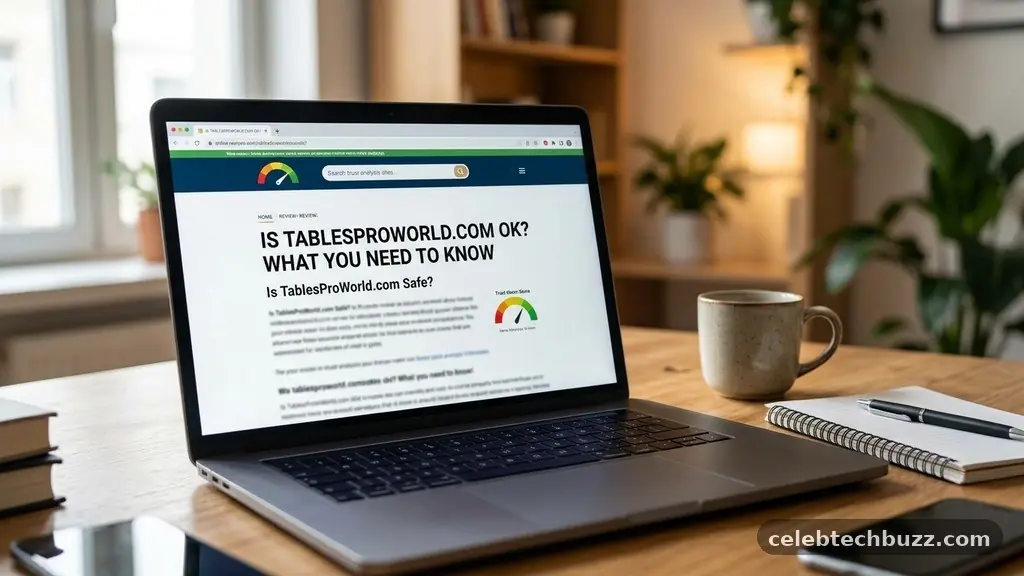
Questions about whether TablesProWorld.com is trustworthy deserve a careful answer, especially if the site asks for payment or personal details. The practical answer behind “Is TablesProWorld com Ok? What You Need to Know” is that a website cannot be judged safely from its appearance alone, and there is not enough independently verified information here to declare TablesProWorld.com safe without checking its current records, policies, ownership details, and customer history.
That doesn’t automatically mean the store is a scam. It means shoppers should treat the site as unverified until the evidence supports it. The checks below show what to examine before ordering, which warning signs matter most, and how to protect your money if the website fails to provide clear answers.
The Short Answer: Is TablesProWorld.com Safe?
At this stage, the most responsible verdict is “use caution and verify before buying,” not “definitely safe” or “definitely fraudulent.” A trustworthy assessment requires current information about the domain, company ownership, customer reviews, payment processing, delivery promises, and refund procedures.
A polished storefront proves very little. Online shops can copy professional layouts, product photographs, terms pages, and familiar payment logos within hours, while a legitimate small business may have a simple design and limited public visibility.
The first question is whether TablesProWorld.com provides a real business identity that can be checked outside the website. Look for a company name, business address, working email address, telephone number, and registration details that match across multiple sources.
Next, inspect the purchasing terms before adding anything to a basket. A credible store should explain what customers are buying, how much shipping costs, how long delivery takes, how returns work, and which party pays return postage.
A scam checker can provide useful clues, but its trust score should never be treated as a final verdict. Automated services often rely on domain age, hosting data, technical configuration, and patterns associated with suspicious websites; they usually cannot confirm that products will arrive or that customer service will respond.
Why a Website’s Appearance Isn’t Proof
Many questionable stores look convincing because visual credibility is easy to manufacture. A clean logo, a secure-looking checkout, countdown timers, “limited stock” messages, and prominent discounts may encourage fast decisions without proving anything about the company behind the site.
Product descriptions also need scrutiny. If several unrelated products use identical wording, awkwardly translated sentences, or photographs that appear on many other stores, the catalogue may have been copied from suppliers or competing websites.
Price is another clue, but not a verdict by itself. A temporary sale can be genuine, while a price dramatically below the normal market range may signal counterfeit goods, poor-quality substitutes, hidden shipping charges, or an attempt to collect payment without fulfilling orders.
Check whether the website makes precise claims it can support. Statements such as “trusted by thousands” or “the leading retailer” should be treated as marketing unless the store identifies the evidence, names the business behind the claim, or links to independent coverage.
Trust badges require the same caution. A payment logo or security badge is meaningful only if it is connected to a real service and works as expected; an image pasted into a page does not show that a company has passed any inspection.
Website legitimacy is best judged through several independent signals. The strongest combination includes a verifiable business identity, an established domain history, consistent contact information, transparent policies, credible customer reviews, and a payment method that offers meaningful dispute protection.
What a reassuring site usually provides
- A legal business name that matches public records and customer-service communications.
- A physical business address that can be checked rather than a vague “worldwide warehouse” claim.
- Clear delivery estimates, shipping charges, and tracking information.
- A refund policy that explains deadlines, conditions, and the return destination.
- Independent customer reviews that include specific product and delivery details.
- Payment methods with buyer protection, rather than only bank transfer, cryptocurrency, or unusual payment links.
Domain Registration and WHOIS Checks
A domain registration check can reveal useful background about TablesProWorld.com. A WHOIS lookup may show the registration date, registrar, name servers, and sometimes the registrant’s country, although privacy services commonly hide the individual or company name.
A recently registered domain is not automatically dangerous. New businesses launch every day, and a small retailer may have operated through another channel before creating a dedicated store. Still, a brand making large claims while using a very new domain deserves more verification than an established business with a long, consistent history.
Pay attention to mismatches. If the site claims to be a long-running American company but its domain history, delivery terms, currency, and contact details point elsewhere, the explanation should be clear before you place an order.
Domain registration information can also expose frequent changes. A domain that has moved between registrars, changed nameservers repeatedly, or adopted several unrelated website identities may need closer examination, particularly if the current store has little independent history.
Privacy protection alone is not a red flag. Many legitimate businesses use privacy services to reduce spam and protect personal information. The issue is whether the business voluntarily supplies a legal name, address, and responsive contact channel elsewhere on the website.
Domain age should be considered alongside customer history. An old domain can still host a new or compromised store, while a newer domain can belong to an honest entrepreneur. That is why registration data is a supporting clue rather than a complete website legitimacy report.
Questions to ask during a domain check
Find out whether the domain name matches the company name, whether the website’s contact email uses the same domain, and whether the store’s claimed location makes sense. A free email account, a different company name in the checkout, or a sudden redirect to another domain deserves an explanation.
Also check whether the site uses a consistent brand spelling. Small differences such as an extra hyphen, unusual extension, or swapped letters can indicate an impersonation attempt, especially when the copied design resembles a better-known store.
SSL, Encryption, and Website Security
TablesProWorld.com should use HTTPS on its homepage, product pages, login area, and checkout. The padlock and valid SSL certificate show that data travelling between your browser and the site is encrypted, reducing the risk of simple interception.
That protection is important, but it does not certify the seller. A fraudulent website can obtain an SSL certificate just as a legitimate one can, because certificates generally confirm control of a domain rather than the honesty, solvency, or product quality of the operator.
Check the exact address in the browser bar. A secure page should use the correct domain, not a lookalike address, a long sequence of unrelated subdomains, or a checkout page that suddenly moves to an unfamiliar site without an understandable explanation.
Browser warnings should be taken seriously. If your browser reports an invalid certificate, deceptive content, malware, or an unsafe connection, close the page rather than bypassing the warning to complete an order.
Other website security clues include sensible account protection, clear privacy information, and a checkout that does not request unnecessary data. A retailer normally needs a delivery address and payment details, but it should not ask for unrelated passwords, banking login credentials, or copies of identity documents without a compelling, verifiable reason.
Use a separate password for any account created on the site. If you reused that password elsewhere and later become concerned, change it immediately on the other services, starting with email and financial accounts.
The important distinction is simple: HTTPS protects the connection, while business verification protects the decision. You need both layers, and neither one replaces the other.
Business Identity and Contact Information
A genuine online retailer should make it possible to identify the people or company responsible for the transaction. TablesProWorld.com should provide more than a contact form; useful contact information includes a company name, business address, customer-service email, and a telephone number that connects to a real support channel.
Test the details before spending money. Send a short question about stock, delivery time, or returns and note whether the response is specific, timely, and consistent with the published policies.
A business address deserves independent checking. Search the address in a mapping service, business directory, or public corporate record, while remembering that a home office, shared workspace, or fulfilment centre can be legitimate for a small retailer.
The concern is not that an address is modest. The concern is that it leads to an unrelated residence, an empty plot, a mail-forwarding service with no disclosed company identity, or a building that has no apparent connection to the business.
Company registration can add confidence when the seller claims to operate as a corporation or limited company. The name, registration number, jurisdiction, and address should align with the website’s terms and the name shown on receipts.
Watch for inconsistent legal wording. A footer may identify one business, while the refund policy names another, and the payment descriptor may show a third. Sometimes this reflects a parent company or fulfilment partner, but the relationship should be explained before purchase.
Do not assume a social-media profile proves identity. A newly created account with copied images and comments disabled can be part of a temporary sales campaign rather than a longstanding customer-service presence.
A real business does not need to reveal an owner’s private home details. It does need to provide enough information for a customer to understand who accepted the payment and where a complaint or return should be directed.
Customer Reviews and Independent Reputation
Customer reviews can show whether a store delivers what it promises, but only when they come from independent sources. Testimonials displayed exclusively on TablesProWorld.com are selected by the seller and may not represent the full customer experience.
Search the exact domain name in quotation marks, then try variations that include “reviews,” “complaints,” “refund,” and “delivery.” Look for detailed accounts that mention order dates, product names, shipping carriers, communication, and the outcome of any dispute.
Review patterns matter more than a single angry comment. A legitimate company may receive complaints about delays or damaged goods, yet it should usually have a history of specific, varied feedback and visible attempts to resolve problems.
Be cautious with pages that contain dozens of reviews written in the same tone. Repeated phrases, identical sentence structures, generic five-star praise, and reviews appearing within a short period can suggest manufactured feedback.
On the other hand, a lack of reviews is not proof of fraud. A new domain may simply have few customers, or the company may sell through a marketplace under a different name. The absence of independent evidence means you should limit the amount at risk rather than assume the best.
Check whether reviewers describe the same business. A search result may combine similarly named retailers, and a profile may refer to a different domain, product category, or country. Confirm the URL before treating a review as relevant to TablesProWorld.com.
When reading marketplace feedback, separate product quality from seller performance. A good product can be sold by an unreliable retailer, while a poor review may criticise an item rather than the company’s payment, delivery, or refund practices.
Reputation should also be current. A store may have changed ownership, suppliers, or fulfilment arrangements, so reviews from several years ago cannot fully describe present service. Recent complaints about missing orders or unanswered refunds deserve particular weight.
Payment Methods, Refunds, and Delivery Policies
The checkout process is where risk becomes financial. Before entering card details, read the payment methods, currency, shipping policy, refund policy, and terms governing damaged, incorrect, or missing orders.
Credit cards and established payment services generally provide stronger dispute options than direct bank transfers, cryptocurrency, gift cards, or payment links sent through private messages. Protection varies by country and provider, so confirm the rules that apply to your account rather than assuming every transaction is reversible.
A seller that accepts only irreversible payment methods creates a serious warning sign. Legitimate businesses may prefer particular processors, but many can offer at least one conventional method that gives buyers a documented transaction record and a route for raising a dispute.
Inspect the final payment page carefully. The merchant name shown by your card issuer or payment provider may differ from the storefront because of a parent company, but a completely unrelated name should be clarified before authorisation.
| Area to check | More reassuring sign | Reason for caution |
|---|---|---|
| Payment methods | Recognised card or payment service with transaction protection | Only bank transfer, cryptocurrency, gift cards, or unusual links |
| Refund policy | Clear deadline, return address, conditions, and processing expectations | Vague wording, impossible conditions, or no return procedure |
| Shipping policy | Named delivery regions, realistic estimates, and tracking details | Unclear origin, indefinite delivery, or unexpected charges at checkout |
| Order records | Immediate receipt with item, price, merchant, and support details | No confirmation, mismatched merchant, or receipt from a free email account |
Look for hidden conditions in the refund policy. Some stores advertise “money back” but exclude sale items, opened packaging, international orders, or products that are difficult to return, leaving shoppers with little practical remedy.
Delivery language should be equally precise. “Ships worldwide” does not explain where goods originate, which carrier is used, how customs charges work, or what happens if tracking stops updating.
Save copies of the product page, checkout total, policies, order confirmation, and every email. Screenshots are useful because policies and prices can change after an order is placed.
Red Flags That Should Stop an Order
One warning sign may have an innocent explanation, but several together should change your decision. A store becomes especially risky when it combines extreme discounts, pressure to buy immediately, vague ownership, copied content, and payment methods that offer little recourse.
Urgency deserves attention. Countdown clocks that reset, repeated claims that only one item remains, or pop-ups announcing purchases from people you cannot verify are designed to shorten the time available for research.
Be careful with unusually generous promises. Free international shipping, guaranteed arrival dates, no-questions-asked refunds, and luxury products at a fraction of their normal price may be genuine promotions, but the seller should explain how those offers work in precise terms.
Grammar alone is not a reliable fraud test. Honest businesses can make language mistakes, particularly when operating across countries, while sophisticated scam sites can use polished copy. The stronger issue is whether wording creates confusion about the legal seller, delivery obligations, or return rights.
Missing policy pages are more significant. If the website has no refund policy, no privacy notice, no shipping terms, or only generic text that never identifies the company, you cannot properly assess the transaction.
Another serious sign is pressure from customer support to move outside the normal checkout. Requests to pay through a personal account, send a bank transfer “to release” an order, or share a one-time security code should be refused.
Do not let a small first order create false confidence. Some dishonest operations fulfil inexpensive orders while using larger purchases to collect more money or personal information.
A practical stop-and-check rule
Pause if you cannot independently answer three questions: who is selling the item, how can you get your money back, and what evidence shows that other customers received their orders? If any answer is unclear, postpone the purchase until the seller responds with verifiable information.
How to Shop More Safely on an Unfamiliar Site
If you still want to consider TablesProWorld.com after checking its information, reduce the possible loss. Start with a small order rather than an expensive purchase, and avoid buying anything you urgently need for a specific date.
Use a payment method that supports disputes and enable transaction alerts. Never share a card PIN, banking password, verification code, or remote-access permission with a seller or supposed delivery agent.
Create an account only if necessary. Guest checkout reduces the amount of stored information, and a unique password limits the damage if the retailer’s database is compromised.
Record the seller’s promises before ordering. Save screenshots of the advertised price, stock statement, estimated delivery, return terms, and business details, then keep the order confirmation and tracking messages in one folder.
Inspect the confirmation immediately. Check that the item, quantity, tax, shipping fee, delivery address, and total match what you authorised. An unexpected subscription, insurance charge, or currency conversion should be challenged promptly.
Monitor the order within the promised window. A tracking number that never activates, changes to an unrelated carrier, or remains stuck without explanation can justify contacting the payment provider before a dispute deadline expires.
If the seller stops responding, contact the payment provider using its official website or phone number. Do not rely on a link in a suspicious email, and do not close a dispute merely because the merchant promises a future refund without evidence.
Online shopping safety also includes protecting your wider identity. If you submitted more personal information than necessary, watch for unfamiliar login attempts, new account notifications, suspicious calls, and emails that imitate the retailer or your bank.
When a site appears clearly deceptive, report it to the relevant consumer-protection authority, domain registrar, payment provider, and browser security service. Reporting cannot guarantee recovery, but it may help limit further harm.
How to Interpret a Scam Checker’s Trust Score
A scam checker can help you create a first-pass risk profile, particularly when it identifies a very new domain, suspicious hosting patterns, malware warnings, or a history of abuse. It is useful as a prompt for further research, not as a substitute for checking the seller directly.
Trust scores are generated differently. One service may heavily weight domain age, another may focus on technical security, and a third may use user reports. Because the methods vary, two tools can produce different results without either one having complete information.
Technical data can also become outdated. A domain may change ownership, move hosting providers, renew its certificate, or launch a new store after an automated report was created.
Read the explanation behind a score instead of focusing on the number. A low score caused by a new registration is a different concern from a low score associated with malware, phishing reports, payment abuse, or a pattern of copied websites.
Likewise, a high score does not guarantee fulfilment. It may mean the domain has existed for years and has no obvious technical warnings, while customer service, product quality, or refund handling remains unknown.
Use a scam checker alongside a WHOIS lookup, independent review search, policy inspection, and a direct test of contact information. The more important the purchase, the more independent evidence you should require.
If the available information conflicts, choose the safer interpretation. A business that cannot explain why its legal name, address, payment descriptor, and online reputation do not match should not receive a large payment.
Frequently Asked Questions
Is TablesProWorld.com definitely a scam?
No definite conclusion should be made without current, verifiable evidence. The absence of enough reliable public information means the site should be treated as unverified, not automatically labelled fraudulent or endorsed as safe.
Does an SSL certificate make TablesProWorld.com trustworthy?
No. An SSL certificate encrypts the connection between your browser and the website, but it does not confirm the operator’s identity, product quality, delivery performance, or refund behaviour.
What should I check before placing an order?
Verify the company name, business address, contact information, domain history, customer reviews, payment methods, refund policy, and shipping policy. Make sure the checkout uses a payment option with meaningful dispute protection.
What if I already paid and the order has not arrived?
Save all records, contact the seller once through an official channel, and monitor the payment-provider deadline for a dispute. If the seller does not provide a credible resolution, contact your card issuer or payment service promptly and explain the missing order.
Can a high trust score prove that a store will deliver?
No. A trust score may reflect technical signals or domain history, but it cannot guarantee inventory, delivery, customer support, or refunds. Treat it as one piece of evidence among several.
Final Takeaway
The honest answer to “Is TablesProWorld com Ok? What You Need to Know” is to proceed only after independent verification. Check the domain, business identity, customer history, policies, checkout details, and payment protection rather than relying on design, discounts, or a single trust score.
If the seller cannot explain who it is, where it operates, how it handles refunds, or why customers should trust it, don’t place a large order. A cautious pause is cheaper than trying to recover money after a preventable shopping problem.