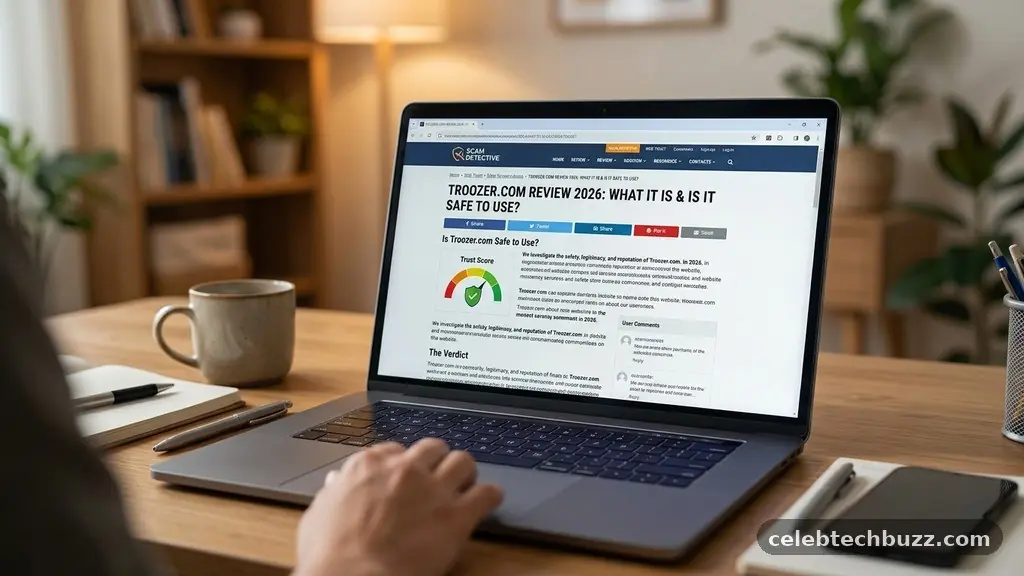
Troozer com Review 2026 searches usually come from people trying to decide whether Troozer.com is a genuine online store or a risky website. The short answer is that its safety cannot be confirmed from the domain name alone, and shoppers should treat the site as unverified until its ownership, business details, customer history, and checkout protections have been checked.
That matters because polished design, discounts, and an SSL certificate don’t prove that a retailer will deliver orders or issue refunds. A careful website safety check can reveal useful warning signs before money or personal information changes hands.
Is Troozer.com Safe to Use?
Based on the information that can be responsibly stated without independently verified business records, Troozer.com should be treated as unverified rather than automatically safe. A Troozer review 2026 cannot honestly declare the website legitimate or a scam simply because the store has a working homepage, attractive product pages, or secure-looking checkout screens.
The most sensible approach is to avoid placing a large order until several points line up: a verifiable company identity, a real address, responsive contact information, consistent customer reviews, clear payment methods, and a refund policy that explains who pays return shipping. If those details are missing or copied from other websites, the risk rises sharply.
That is not the same as proving a Troozer scam. A new or small retailer may have limited online history without being fraudulent, while an established-looking site can still create problems for customers. The correct verdict in an uncertain case is cautious: do not send money by bank transfer, cryptocurrency, gift card, or another payment method with weak buyer protection.
Readers should also distinguish between technical security and commercial trust. A browser padlock indicates encrypted communication between the device and the website, but it does not confirm that products exist, that prices are genuine, or that the operator will honour a refund request.
What Troozer.com Appears to Be
Troozer.com appears to be presented as an online shopping website, but the exact product range, operator, location, and trading history need to be verified directly rather than assumed from the domain. A store’s visual appearance is only the front layer of the business; the more useful evidence sits in its policies, company disclosures, checkout process, and independent reputation.
Some questionable shops use a broad catalogue with products copied from manufacturers or marketplaces. Others advertise a narrow selection, unusually low prices, or short-lived promotions designed to push visitors toward a quick purchase. None of those traits proves misconduct on its own, but several appearing together deserve careful attention.
Pay close attention to whether product descriptions sound original and specific. Genuine retailers usually provide useful information such as model numbers, dimensions, materials, compatibility details, stock status, and realistic delivery estimates rather than relying on vague phrases and generic photographs.
A legitimate store should also make its commercial identity visible. Look for a registered business name, a physical mailing address, a working customer-service email, and a telephone number that connects to a real support channel instead of a form that never receives a reply.
The domain name itself is not evidence of authenticity. A short, memorable name can belong to a proper business, a temporary dropshipping operation, or a site created for a short-term scam. The question is whether the website’s claims can be checked against independent sources.
How to Check Troozer Legitimacy
A useful Troozer legitimacy review starts with facts that are difficult for a dishonest operator to fake consistently. Begin with the website’s “About,” “Contact,” “Terms,” “Privacy,” “Shipping,” and “Refund” pages, then compare the information across all of them. A company name that changes between pages is a serious warning sign.
Next, search the stated company name and address separately from the website. A map listing, government business register, professional directory, or established marketplace profile can help establish whether the business exists beyond its own domain. Be cautious if the address leads to an empty lot, a residential property with no related business evidence, or an unrelated organisation.
A WHOIS lookup can show registration dates, registrar information, and whether ownership details are protected by a privacy service. Privacy protection is common and does not prove fraud, but a very young domain paired with deep discounts, copied text, and no independent reviews should receive extra scrutiny.
Domain age is useful context, not a verdict. Older domains can be compromised or repurposed, while a new domain can belong to an honest start-up that simply has not built a public history yet.
Use several checks together rather than trusting one automated trust score. Reputation tools may disagree, may lack current data, or may assign a low score to a new but harmless site; a high score also cannot guarantee order fulfilment.
- Confirm that the business name and address remain consistent across the site.
- Check the domain age and registration details with a reputable WHOIS lookup service.
- Search for independent customer reviews using the store name, domain, and product names.
- Inspect the refund policy for deadlines, exclusions, return costs, and contact instructions.
- Test customer support with a specific pre-sale question before ordering.
- Save screenshots of prices, delivery promises, product descriptions, and policies.
Technical Safety: SSL, Malware, and Phishing
A website safety check should include technical risks as well as shopping risks. An SSL certificate means the connection uses encryption, which helps protect information while it travels between a browser and the site. It does not tell you whether Troozer.com is operated by a genuine retailer.
Scammers can obtain basic certificates, and many legitimate websites use them automatically through their hosting provider. The padlock is therefore a minimum requirement, not a trust badge. If the site lacks HTTPS or produces browser certificate warnings, stop before entering any information.
Check the exact spelling of the address in the browser bar. Fraudsters sometimes use lookalike domains, extra words, unusual extensions, or substituted letters to imitate a familiar shop. A search advertisement can also lead to a different domain from the brand name shown in the advert.
Malware and phishing risks may appear through pop-ups, fake browser alerts, forced downloads, or requests to install an extension. No online retailer needs a shopper to install unknown software to view a product, complete payment, or receive tracking information.
Messages that claim an order is delayed and ask for card details should be handled separately from the website. Open the retailer by typing the known address into the browser rather than clicking a link in an unexpected email or text.
For practical advice on suspicious messages and deceptive requests, the Federal Trade Commission’s guidance on recognising and avoiding phishing scams explains common tactics and safer responses. That advice applies even when a message appears to use Troozer branding.
Prices, Products, and Shopping Signals
Price is one of the most tempting signals in an online purchase, but it is also easy to manipulate. A product listed far below the normal price may be a genuine clearance item, an inaccurate listing, a counterfeit, or bait for collecting payment details.
Compare the same product across several established retailers, including the manufacturer where possible. Look beyond the headline discount and examine delivery charges, taxes, currency conversion, minimum order values, and whether the item is actually in stock.
Product photography can provide clues. Identical images appearing on unrelated sites are common in ecommerce, so the images alone prove little; however, a catalogue filled with watermarked photographs, inconsistent backgrounds, or descriptions that mention a different company suggests the store may have copied its listings.
Read the specifications carefully before judging value. A listing might show a premium product photograph while the small print describes a compatible accessory, replacement part, sample, or lower-capacity version. Honest product pages make those distinctions clear.
Delivery language deserves equal attention. “Ships in one to three days” may describe dispatch rather than arrival, while “international warehouse” can mean long delivery times, import charges, and difficult returns. A credible shop should state the shipping origin or at least explain the expected delivery window.
Urgency messages deserve restraint. Countdown timers, “only two left” notices, and repeated pop-ups can encourage an impulsive purchase, but they do not establish stock levels or business legitimacy. If the offer disappears after you take time to verify the store, that is a reason to walk away, not a reason to rush.
Customer Reviews and Reputation
Customer reviews are valuable only when they are independent, specific, and varied. A row of five-star comments on Troozer.com may describe the site’s own publishing process rather than real buying experiences, especially when every review uses similar wording or appears within a short period.
Search the domain name in quotation marks alongside words such as “review,” “complaint,” “refund,” and “delivery.” Also search individual product names, because a store can have little direct coverage while the advertised goods have a known history elsewhere.
Negative reviews do not automatically prove a Troozer scam. Legitimate shops can have isolated complaints caused by courier delays, damaged parcels, sizing problems, or customer misunderstandings. The important pattern is how often the same issue appears and whether the business responds with specific, credible solutions.
Look for evidence that a reviewer actually completed a transaction. Useful details include the order date, delivery country, tracking experience, packaging, product condition, and refund outcome. Generic praise such as “great website” or “high quality” tells a shopper very little.
Review platforms can also contain false positives and false negatives. Some businesses encourage only satisfied customers to post, while competitors or automated accounts may submit hostile comments. Treat the review record as one part of the assessment, not a replacement for checking payment protection and company identity.
| Reputation signal | What it may indicate | How much weight to give it |
|---|---|---|
| Detailed reviews across independent platforms | Real customers may have used the store | Useful, especially when dates and outcomes vary |
| Only testimonials on Troozer.com | Marketing material controlled by the seller | Low evidential value |
| Repeated complaints about non-delivery | A possible fulfilment or fraud pattern | High concern if recent and unanswered |
| Very young domain with no customer history | New business or short operating history | Requires stronger checks before payment |
Payment Methods and Buyer Protection
The payment screen often reveals more about risk than the homepage. Prefer a credit card or a reputable payment service that provides a documented dispute process, because those options may offer a route to recover funds if the item never arrives or is materially different from the listing.
A debit card may still provide protections depending on the bank and country, but the process can differ from credit-card chargeback procedures. Check the account provider’s rules before paying, particularly for an expensive order.
A request for cryptocurrency, gift cards, direct bank transfer, cash deposit, or payment through an unfamiliar wallet is a major warning sign. These methods can be difficult or impossible to reverse, which is exactly why fraudulent sellers often prefer them.
Confirm the final amount before authorising payment. Watch for unexpected subscription language, insurance add-ons, currency conversion fees, or shipping charges that appear only at the last step. A legitimate checkout should show the total clearly and provide a receipt.
Never send card details through email, social media messages, or a chat window. If a customer-service representative asks for a one-time password, full account password, or remote access to your device, end the conversation and contact the payment provider through its official app or website.
Use a unique password if creating an account. Do not reuse the password from your email, bank, or social media, because a data breach at a small retailer could expose credentials used elsewhere.
Refund Policy, Delivery, and Customer Support
A refund policy should answer practical questions, not merely promise satisfaction. Check the return period, product exclusions, condition requirements, return address, processing time, refund method, and responsibility for postage. If those points are missing, the policy may be difficult to enforce when a problem occurs.
Some websites copy a generic refund page that mentions another company or uses inconsistent branding. That error is especially concerning because it suggests the operator has not reviewed its legal and customer-service information. Save a copy before ordering, since policies can change after a purchase.
Contact information should be tested before payment. Send a short question about stock or delivery and see whether the reply addresses the exact question, arrives from the same business domain, and provides a useful answer rather than a scripted discount.
A genuine support team may not respond instantly, but the response should still be coherent and professional. An unanswered email, bounced address, empty telephone line, or social account that was created recently provides little comfort for a buyer dealing with a missing parcel.
Delivery promises should be realistic for the destination. International shipping can involve customs inspection, import tax, local courier handoffs, and delays that are outside a retailer’s direct control; a responsible store explains those conditions rather than guaranteeing an implausibly fast arrival everywhere.
Before buying, decide what evidence you would need in a dispute. Keep the order confirmation, invoice, tracking number, screenshots, support messages, and photographs of the parcel. This record can make a payment-provider complaint much clearer if the retailer stops responding.
Common Red Flags and Safer Buying Steps
No single warning sign proves that Troozer.com is fraudulent, but several weak signals can combine into a strong reason not to proceed. The most concerning pattern is an aggressive offer paired with hidden ownership, copied policies, limited contact options, and payment methods that remove buyer protection.
Watch for spelling mistakes in legal pages, mismatched currencies, product reviews that refer to unrelated items, and social-media icons that lead nowhere. A site may contain minor errors and still be genuine, but a collection of these problems indicates poor accountability.
Take a pause before checkout. A few minutes spent comparing the offer and verifying the company is usually more valuable than a discount that expires while you investigate.
If you decide to test the store despite limited history, use the smallest reasonable order and a protected payment method. Do not upload identity documents unless the business has a clear, lawful reason and you have independently confirmed who will receive them.
Use this practical decision rule:
- Proceed cautiously only when the company identity, policies, reviews, and payment protections are reasonably consistent.
- Delay the purchase when the site is new, support is unresponsive, or independent information is scarce.
- Do not pay when the seller demands irreversible payment, makes implausible promises, or requests unnecessary personal information.
- Contact your provider quickly if you have paid and the order becomes suspicious or the seller stops responding.
What to Do If You Already Ordered
If an order has already been placed, do not panic, but act methodically. Save every email, receipt, tracking page, chat message, product screenshot, and policy page associated with the transaction.
Monitor the payment account for unfamiliar charges. If the site took card details and then behaves suspiciously, contact the card issuer through the number on the card, explain what happened, and ask what monitoring or replacement options are available.
Give the retailer a clear written deadline if the promised delivery period has passed. State the order number, the problem, the remedy requested, and the date by which you expect a response. Keep the message factual rather than sending repeated emotional complaints that obscure the key evidence.
If the seller does not resolve the matter, ask the payment provider about its dispute or chargeback process. Deadlines vary, so waiting for several months can weaken your options.
Change any password reused on the website, especially if the account contained personal details. Enable multi-factor authentication on your email and financial accounts, since email access can allow an attacker to reset other passwords.
Be alert for a second scam after the first problem. Fraudsters sometimes contact disappointed shoppers while pretending to be recovery agents, customs officers, or payment investigators, then request an extra fee or remote access. A genuine bank or official agency will not require cryptocurrency or gift cards to recover funds.
FAQ About the Troozer Review 2026
Is Troozer.com definitely a scam?
No definitive conclusion should be made without verified evidence. The safer assessment is that the site should be treated as unverified until its business identity, independent customer history, refund policy, and payment protections have been checked.
Does an SSL certificate prove Troozer.com is legitimate?
No. An SSL certificate encrypts the connection between your browser and the website, but it does not verify ownership, product availability, delivery performance, or refund behaviour. It is a technical security baseline, not proof of commercial trust.
What payment method is safest for an uncertain online shop?
A credit card or a reputable payment service with a clear dispute process is generally preferable to bank transfer, cryptocurrency, gift cards, or direct cash payments. Protection depends on your country, provider, and circumstances, so review the applicable terms before ordering.
How can I check the domain age and ownership?
Use a reputable WHOIS lookup tool to review the domain’s registration date, registrar, and available ownership information. Privacy-protected records are common, and domain age alone cannot establish legitimacy, so combine the result with company-register checks, customer reviews, and policy analysis.
What should I do if Troozer.com does not deliver?
Contact the seller in writing, preserve your order evidence, and contact the card issuer or payment provider promptly about its dispute process. Change reused passwords and watch for follow-up phishing messages that promise refunds in exchange for another payment.
Final Verdict
A careful Troozer com Review 2026 does not support treating Troozer.com as automatically safe simply because it loads correctly or displays a padlock. Until independent evidence confirms the operator, delivery record, customer support, and refund practices, cautious shoppers should avoid expensive orders and irreversible payment methods.
Check the domain age, WHOIS details, customer reviews, contact information, policy wording, and checkout protections before deciding. If several answers remain unclear, walking away is the strongest safety decision—and sharing your verified experience can help other shoppers make a better-informed choice.